Translate

Thursday, May 28, 2015

Lennon: Celebrating the Music of John Lennon

Let's be clear: the Lennon show wasn't really my idea.

In fact, it was already in creation long before I showed up to the scene; several sculptors, headed by Tim Bruckner, collaborated together to create small pieces of resin-cast sculptures of John Lennon, with the intention of travelling overseas with May Pang on her newest book tour through Germany in 2014. Problems arose, however, and the promoter decided it was not prudent to ship and travel the pieces, and the sculpture segment of the tour was dead in the water.
May Pang and John Lennon
Then I got the call... would Krab Jab Studio be interested in hosting a John Lennon-inspired art show?

Had these artists been anyone else, I would have passed. However, I had worked with Tim in the past, and all the sculptors involved were professionals in the toy and entertainment industry, many of which did sculpts for things like DC Comics, Marvel Comics, or character development for movies (like Michael Defeo, for example).  They fulfilled the "publication and entertainment industry" spectrum of the gallery (check!), and all of them were top notch in their field of expertise. Tim Bruckner, a master of sculpture in his own right, also had a strong backstory: he knew May Pang personally, had met John Lennon "back in the day",  and had designed Ringo Starr's first solo album cover (among other things). This wasn't an average, run-of-the-mill tribute show being handed to me.
Designs for Ringo Starr and Harry Nilsson, Tim Bruckner
Problem was, as I explained to Tim in our initial conversation, I had already booked out my 2015 year. He kept insisting I double check my calendar, and I finally did....huh! Seemed, strangely, I had booked out everything but skipped the month of May. Would he want that month? He enthusiastically said yes, and went back to his fellow sculptors to give them the news.

I was still on the fence about the show, though. Tribute shows are hard sells to the public, quite frankly. As I wrapped up work for that particular day, I decided that if a John Lennon song came on the radio when I hopped into my car, I would do it. Knowing that was kind of a crap shot, I locked up and jumped into the car to head home.

Imagine was playing on the radio. Done deal.
Imagine, #1/6 resin cast lamp, Tim Bruckner
Tim recruited four more artists (Conny Valentina, Dan Chudzinski and duo Colin and Kristine Poole). We lost a couple folks due to obligation issues, but we had a nice solid eight: Tim, Dan, Conny, Colin and Kristine, Michael Defeo, Alfred Paredes, and James Shoop. Tim looped May Pang in, since she was a photographer and took many photos of John during her time with him (coined "The Lost Weekend"). May was somewhat stand offish, however. After a month of spotty emails, she finally called me to explain to me why she wasn't really feeling the show - she just didn't think she was a good fit. She did the "it's not you, it's me" explanation, which I took fairly well, I think. Except... well, except we actually enjoyed talking. And talking. And talking... and over an hour later, she sighed and said, "okay, I'll send you nine photographs. Nine was his number, you know."

I made a tiny squee inside. You see, I actually am a John Lennon fan, I actually knew exactly who May was (I even read her book when it came out in 1983 - a bit inappropriate for a 13 year old, but hey, we all grow up sometime). I was just a wee bit star struck.

The whole group had about 6 months to prepare, and the original four sculptors of James, Alfred, Michael and Tim decided to do another piece for the show. All the artists decided to pick their favorite John Lennon song and run with that, and the results were quite marvelous.
Tomorrow Never Knows, Michael Defeo
Yellow Submarine, Dan Chudzinski
Nothing is Real, Alfred Paredes
The Girl with Kaleidoscope Eyes, Colin and Kristine Poole 
Two Spirits (verso), James Shoop
A Little Help from My Friends, Conny Valentina
I Am the Walrus, Tim Bruckner
May did come through and sent her nine photographs which depicted a very intimate portrayal of John Lennon. Most of the photos were taken in their house in LA.
Here's Looking at You, May Pang
It was no surprise at this point that the number nine would pop up yet again, as the show was to open May 9th. For the opening, both Tim and May were able to attend, which was an absolute treat to our visitors. We were hooked up with Steve Roseta and the members of the local Beatles tribute band, Apple Jam, and graciously Josh Jones and Rick Lovrovich provided an acoustical set to the evening, which included all the songs that inspired the show. They even got to serenade May to both "#9 Dream" (she provided the original female vocals to the song) and "Surprise, Surprise".

As an addition, we had a memorabilia wall during the opening, which included a set of John's sunglasses (yes, really), a very rare dye transfer print of the Sgt Peppers album cover (only four known in the world - knowing the actual value of it ranged in the six digits, I was sweating all night in fear something might happen to it), a limited edition John Lennon litho, and a lovely Chris Hopkins ink drawing of John.
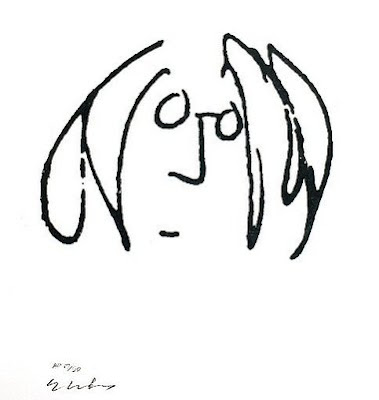
John Lennon, Chris Hopkins, courtesy Steve Roseta

John Lennon lithograph, courtesy Steve Roseta
Sgt Peppers album cover photo, one of four, courtesy Allen Goldblatt
Need I say that the show was a hit with our opening night visitors? Many of them hung out for nearly the whole night to listen to the music, take in the artwork, and chat with both Tim and May. Interactive pieces were played with: Alfred's little strawberries are magnetic and move about the green field, and James' bronze tree revolves on a base, revealing a sleepy eyed John on one side and a smiling awake John on another. People squealed with delight over the lamp within Tim's "Imagine" piece, which displayed logos of various John songs inside the spectacles. Sunlight played off the gold on Colin and Kristine's figure as the sun set lazily, glinting through our windows and throwing long, sad shadows on the concrete floor, reminding us all that the night would eventually have to end.

It's almost a shame that this show is only a month long - with it being the 50th Anniversary of the Beatles first performance and John's 75th birthday, it's like we have this super secret awesome show of fantastic art and photography devoted to one of the most charismatic songwriters of the 20th century. Those who've seen the show have been wowed and hushed and moved all at once, and to stand among the work, in the room, with "In My Life" quietly playing in the background, you feel a deep, nostalgic ache inside, and you know someone really special was taken away from us way too soon. These artists beautifully narrate the soul of his music with humor, sadness, curiosity, and most of all, respect.

"Lennon" will run through June 6th, 2015.

Demystifying the Gallery World: Things an Artist Should Know


So this last weekend I attended the Spectrum Fantastic Art Live convention, which is a medium sized convention located in Kansas City, MO. It's about three years old and spun off of the juried annual Spectrum Fantastic Art. I went mostly to lurk around, see some kickass art, meet amazing artists and run a workshop called "Demystifying the Gallery World".

The gallery world isn't all that mystical, really. It's just a business. Granted, it can be volatile, unpredictable, baffling, but it's really not all that much from any other business in that there are protocols, contracts, agreements and mostly, relationships. Curator, artist, visitor, collector...

I only had 30 minutes to cover an insane amount of information, so I tried my best to hit as many points as I could, using simple slide shows to bullet point. As requested, I am going to list my slides here, in all their glory.

(Want to See the Actual Workshop? Here it is!)

Developing a show with your curator

  •  Working relationship (key word: “relationship”)
  • — Size of show, size of work(s)
  • — Theme or series
  • — Curatorial vision
  • — Communication! Keep it open, even if there is a problem

Contracted obligations for You and the Curator/Gallery

  • — Written agreement stating terms of show
  • Average retail gallery commission: 40 – 50%
  • Exclusivity clause?
  • Artist usually pays for shipping fees to/from gallery
  • Amendments must be discussed, written and signed by both parties to be legal
  • — Insurance, security, damage or loss of art
  • Marketing obligations, if any

Managing the workload between Confirmation and Delivery

  • Mindful of deadlines vs your own work ethic
  • “Buffer days”/”work days”/”potential sick days”/”FAIL days”
  • Last month is devoted to press releases, marketing, documentation, cataloging
  • Unlike some publishing scenarios, gallery openings are “hard openings”!

Preparing to document your work: Photography, Statement

  • WIP photos are great, especially for a unique process 
  • Traditional 2D: good lighting, clear images, true colors (ie, get a professional if you need to) 
  • 3D: multiple angles, detail shots (video is okay too) 
  • DON’T: use cell phone, photograph a piece under glass (unless you have no choice), or overly Photoshop an image 
  • OIL, metallics, and high gloss mediums: mindful of reflections, blowout, moiré 
  • Statement: reflect the theme of your piece/show. Be heartfelt (visitors can read through bullcrap). First person statements are best. If your medium is unique, you may need to explain what it is or why you used it 
  • DON’T: copy from your website

Framing and Display

DO:
  • Ask about weight/size limitations, as well as wall hanging options and amount of wall space 
  • Wall space: ask about “usable” vs “total” wall space 
  • 3D: Ask about types displays, surface type, if pieces can be anchored, height of displays 
  • Use framing material that is archival – if it is not, alert gallery owner 
  • Ask about frame options on the gallery end, if you are shipping. Many galleries have inhouse framing or framers that are economical. 
DON’T:
  • Use chipped, broken, scuffed frames 
  • Use glass if you plan to ship the piece. Use plexi or matte acrylic 
  • Use a cheap frame (that clearly looks cheap) for expensive pieces. Customers complain about that. 
  • Use odd colors for mats or frames, they’re a harder sell. Use neutral colors such as white, cream, gray, black, beige. 
  • Use toothed hardware. It tends to come out. Use appropriate d-rings, wire.

Shipping your work

When packing 2D art:
  • Ask gallery if they have packing material requirements (such as “no peanuts”) 
  • Don’t pack glass if at all possible 
  • Use foamcore, hardboard or rigid material to protect front of piece 
  • Don’t tape anything directly to your piece or frame 
  • Paper corners, bubble wrap, paper on corners 
  • Don’t overpack a box. Also, make sure pieces will not shift in transit 
  • Don’t use packing tubes for original art 
  • Insure your package! 
When packing 3D art:
  • Crate larger pieces (have one built or buy one at places like Uline
  • “box in a box”, floated 
  • Complex pieces should be broken down into smaller pieces, boxed individually 
  • Send along assembly information and images, including a repair kit 
  • Insure your package!

Pricing your work

  • Materials, time as a factor (adjust if you tend to work slow or fast) 
  • Take in consideration commission rate 
  • Market value: speak to gallery owner about local retail averages vs global averages (example: Grand Rapids may have a higher price point than Anchorage for art) 
  • You may need to make some adjustment to your pricing (or piece choice) to reflect your new locale 
  • Don’t undervalue: your humble $300 price point for your detailed oil painting may say “there is something wrong with this” or “I’m not worth collecting” to a collector. You don’t want to brand yourself as naïve or desperate. 
  • Don’t flux: Collectors get very frustrated with art that’s re-priced from show to show or month to month. If a piece isn’t moving at a current price, RESEARCH WHY. The results may surprise you. Never drop a price…

Market your show: marketing, opening receptions, and review

  • Branding the Art and Show: from Objects to Experience 
  • Social media/Mailing Lists/Preview Lists 
  • Press Releases and advertising 
  • Opening and Closing receptions 
  • Press and collector parties 
  • Reviews: the Good, the Bad, and the Nothing At All

Saturday, April 11, 2015

"Marriage is a Work of Art"

So what does the average person think of when they think of a married artist? Most of us think of stormy rivalries, deceptions, jealousy, a la Frida Kahlo and Diego Rivera. Or we think of one of the artists (usually the wife) putting away her brushes to raise the kids and do the taxes, so selfless, while her partner works tirelessly on his craft.

I know that when I was in art school back in the olden days, I was terribly allergic to the concept of dating, much less marrying, another artist. I was self-aware enough to know my competitiveness would ultimately thwart the relationship, plus, if you've gone to a classic art school (especially 20+ years back), the odds of getting hooked up with a self-absorbed prig was pretty high. No, a regular Joe was the only option for me, and I did in fact marry 20 years ago to, of all people, a boy from my high school crowd I bumped into while in college and reacquainted myself with. None of my artsy couple friends lasted more than a year or so, much less married.

So, can love and art survive together in wedded bliss? And if so, how?

I've met some lovely couples in the art world, and it apparently seemed that marriage can work, and in many ways, bolster the creative works of both people in the marriage. In talking with many of these couples, it occurred to me that this would make a really interesting exhibit. I invited seven couples and gave each of them free reign to use a wall space however they choose.

A few of these couples are barely out of newlywed status, such as Mark and Sara (nee Betsy) Winters and Justin and Annie Stegg Gerard. A few of them span decades, such as Norman and Tory Taber and Brian and Wendy Froud. But no matter how new or established the relationship, it's abundantly clear that something was worked out between them, and the result is very special.

Take Greg Spalenka and Roxana Villa, for example. This couple married later in life and although Roxana has an art background and can hold her own with illustration, she became enamored of the world of scents and perfume. Sensitive to chemicals, she strove to create all natural, unusual scents first for herself, then to sell as Illuminated Perfumes. Greg and Roxana worked together on her product, with him creating art for her packaging and marketing endeavors. The result is sensuous and reflective of her vision (and his as well). These two enjoy working together despite having very different directions in work (he is a graphic artist and workshop instructor with his Artist as Brand).
 #5 Bois, Banner image for Roxana Illuminated Perfumes, Greg Spalenka
 Vinod Rams and Emily Fiegenschuh tend to work differently on a daily basis, with him working in the video game business and Emily working from home on illustration projects. They met and bonded over drawing, and it's clear that this lively couple enjoy each others company. Although they seem to think their work is totally different, it's pretty easy to see they influence each other heavily in their work. Both enjoy working in gouache (which is a type of opaque watercolor) and one can guess these two probably sit up late at night together eating Emily's delicious brownies (she bakes) and chatting and laughing while painting away at their respective drafting tables.
Children of the Forest, gouache, Emily Fiegenschuh
The Green Man, gouache, Vinod Rams
Norman and Tory Taber have been working together on children's books for ages (see Rufus at Work), and both know how to collaborate together without killing each other. Norm works as an art instructor at SUNY Plattsburgh, and Tory works from home on her illustrations while raising their two daughters. Both of them work in separate studios, and Norm has been developing his assemblage work of found architectural objects as well as antiquated and quirky photography. Tory has stuck to the tradition of illustration, creating art for ballet and theater posters among other things. Despite having very different styles and modes of working, there is a very clear connection between the two, especially in the love of nature, the fairy realms and their children (which feature regularly in both their work).
Are You Still Cold?, Acrylic and gouache, Tory Taber
Cut the Clouds Full, Assemblage, Norman Taber
Omar and Sheila Rayyan have been together a very long time and have worked side by side supporting each other over the years. She's done the "regular job" thing (often artists have to have at least one of the two work a job to make ends meet while they work on their careers) while he's toiled away at his illustrations, creating an impressive body of work in the last few years. Sheila hasn't been too far behind, working in pencil illustrations but also creating lovely stoneware and pyrography pieces (a burning technique to create designs on wood) through her Mother Spoon Studio. They have very different styles of working, but both share a sense of humor in their work and relationship that no doubt keeps the creative fires burning.
Princess' New Pony, Oil, Omar Rayyan
Sun, Stoneware, Sheila Rayyan
Mark and Sara Winters are very recently married, but with Sara's old soul (she's 25 years old) and their clear respect for each other, it's like they've been together much much longer. When they work together at home, they often critique each other's work ("brutally honest" is how Sara puts it) and help each other stick to their deadlines, as both work in the game industry as illustrators. This is a very competitive industry and it's easy to get hung up on how many contracts one pulls in versus the other, but these two can hold their own and more importantly, they see the bigger picture.
Medusa, canvas print of oil painting, Mark Winters
Serra, Digital painting with gold leaf on canvas, Sara Winters
Justin Gerard and Annie Stegg Gerard are another newlywed couple, and easily the darlings in the imaginative realism circuit. Funny, bubbly, attractive and incredibly friendly, it's hard to not like this current Power Couple, as they both have been burning up the publication industry as of late, winning awards and accolades all over the continental US. But they keep it real: Annie just wants to raise chickens in the backyard of their Georgia home, and both love painting together. Iconic and mythic imagery arises from their brushes and pencils: Justin's work has a strong nod to classic illustration, while Annie is clearly following the path of the PreRaphaelite. I have a feeling this relationship has a long, successful road: they simply adore each other.
Limnaee of the Lake, Oil, Annie Stegg Gerard
The Last of His Kind, Oil, Justin Gerard
And finally, we have Brian and Wendy Froud, married 35 years and counting. They met while "The Dark Crystal" was in production (she worked for Jim Henson, he was the concept designer for the movie). Both collaborated for "Labyrinth" (including using their own baby Toby for "baby Toby" in the movie) and she's popped up as his fairy model from time to time over the years. While they both have very clear, defined styles (she's stayed true to her sculptural roots, and he continues to draw and paint the fairy world) they have collaborated together many times, producing several books together. Brian has his head in the clouds and Wendy has her feet planted in the ground, making for a balance that has fueled their relationship all these years.
Kneeling Faery, Watercolor, pencil, color pencil, Brian Froud
Faery Woman, Mixed media polymer clay, Wendy Froud
So okay, you can have it all: a career in the arts and a partner to share it with who understands your passion and drive without it blowing up all over the place. Things don't need to smash, mad screaming doesn't need to occur, and nobody needs to be left behind in the dust. Kids can be raised successfully, families are fed and shod, and you can even have egg laying chickens (if your husband agrees to it). These couples prove that marriage really is a work of art and love can mold and enhance each person to reach his or her greatest potential. I'm definitely sold, and I think anyone visiting this exhibit will surely agree.

"Marriage is a Work of Art" will open April 11th and runs through May 2nd. Online catalog goes live April 12th.

~Julie Baroh, April 2015

Wednesday, April 1, 2015

Ten Questions for Tim Bruckner

Ahh, Tim Bruckner. He snuck up on me like a Seinfeld sideler, sending me an innocuous email a few years back saying he was a sculptor and was hoping I'd check out his work. I get a lot of emails like this, so of course I took a big swig of bad coffee and dug in for another 5 minutes of art perusing I knew would never get back, I clicked the link to his URL and...

...queue the angelic choir.

Uh, this wasn't a pimply 14 year old sending me off to his deviantart account full of misshapen ashtrays from  ceramics class. This was THE Tim Bruckner, the guy that was so masterful a sculptor that his work "looks unreal, like a machine made it," as one of my visitors remarked. His work is seen on the set of The Big Bang Theory, it's in the Smithsonian, and most importantly, his work takes us back to a time when quality art in the public eye was about as American as, uh, pie. Humor, ruggedness, femininity, mystery, it's all there in a Bruckner piece, flawless, perfect.
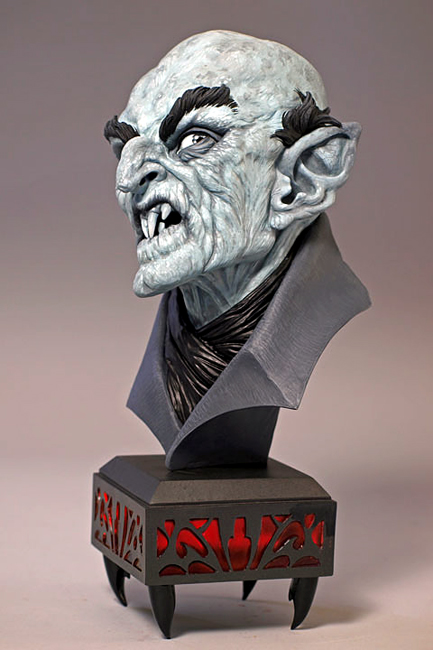
Nosferatu
So I was a little surprised, to say the least. From that email, the Masters of Sculpture show from 2013 was devised to expose Seattle to masterful work so very few of us get to see. Since then, we've taken Tim on board to represent as our newest Krab Jabber. As part of the rites of passage, I've asked Tim ten questions, and without further ado, this is Tim in his own words.

1. What brought you into sculpting? Were you always a sculptor?

I started sculpting when I was seven. I don’t know why. When I was a kid they had these wax tubes filled with a colored liquid so sweet you could go into insulin shock. One afternoon, after finishing a few tubes, I started sculpting the wax into the heads of a couple of the Seven Dwarves.  I thought they were perfect. In hindsight, they probably looked more like somebody’s thumb than Grumpy or Doc. But something clicked that day. I persuaded my mom to take me to buy some clay. And they rest, as they say, is stuff that happened.

2. Do you have a sculptor you admire (both currently and in the past)? How have they inspired your work?

When I was growing up my sculpting heroes were a bunch of old dead guys:  Michelangelo, Bernini, Cellini, St. Gaudens, Gilbert. Nobody in my family was into art. I didn’t know anyone who was. I stumbled upon pix of their work and didn’t get how they did what they did, but I did have a sense of why they did what they did. I was oddly attuned to compositional story telling. So, they inspired me to improve my technical skills to become a better story teller. Its something I’m still working on.  As far as sculptors working today? There are some amazingly talented sculptors. It’s a long list. Many are, I’m lucky to say, my friends. They inspire me daily. First, there’s that little pinch of envy. And then, you feel the challenge. Its not competitive. Its creative curiosity. Why did they make the choices they made. How did they make it happen. And it gets you thinking about your own process, both from a design viewpoint and an execution viewpoint. And ain’t that what art is? Trying to translate the unknown.

3. What was your favorite piece of yours and why?

I have favorites for different reasons. Mostly, I like pieces that worked in spite of myself. Pieces where I was smart enough to get out of my own way and let the piece decide where it wanted to go. That’s not an easy thing to do. With any artist who appreciates the power of technique, its hard to not play into it. When you know what it is you want to say, it’s important  to not oversell it with an artistic sleight of hand. Currently, I like, Belle et la Bete, SHE, He Who Laughs Last, ONE, Something to Consider, Eve Decides and IMAGINE. In a couple of months, the list will change.
Imagine, showing it illuminated from the inside
4. How do you start your sculptures? Do you do drawings first?

With personal work, I very, very rarely do any prep work. As a hands-for-hire sculptor for over forty-six years, working from 2D feels a lot like a job. I have an armature, some clay and some free time. And whatever happens, happens. Like I said earlier, the trick is not to get in the way. But with a piece like I am the Walrus, its such a complex piece, with so many elements, I needed a guide or sorts. And even with the design, I’m discovering things I could not have anticipated in its execution. But Walrus in an exception.
I Am the Walrus, work in progress
5. Has your industry changed a lot since you started? How so? Is it easier/harder?

The industry is significantly different. I’d been a professional for twenty years before I got my first sculpting credit. That meant I had the opportunity to get better. I got to learn. I got to learn how to be a better sculptor and learn what it meant to be a professional. 

Both of those opportunities are almost not available. These days, good, bad or adequate, you get credit. And it follows you. That’s not always a good thing. And there’s almost no place where you get to learn what it is to be a professional. How to understand what the job is and do the job. 

When I started, you either made your own molds, cast your own resins, produced your own paint masters, or you passed it off to someone else, to accommodate some else’s schedule. If I have a three week deadline and I have to budget my time getting my stuff to a mold maker, a caster and a painter, I’ve lost a week, at least, and a week I could be sculpting. The more time with the piece, the chances are you get a better piece. When you do it all yourself, you have total control. Client likes your work, it all on you. If they don’t, the same. You deliver what you mean to deliver, not what someone else thinks you mean. And, all the service costs go into your pocket. But most importantly, when you know each step, all the way to finish, and you understand what you can and can’t do, you are much more likely to produce work that pushes the boundaries of what is possible. 

And that makes you a better designer and a better engineer.

The biggest change, of course, is digital modeling. Almost every major gift, toy or collectible company relies more and more on digital modeling. From their perspective, it’s more efficient. And maybe in some instances, it is. But it’s shifted the production of product from a collaboration between the sculptor and their AD, to solely the discretion and direction of the product manager. And a good many PM’s, have almost no actual 3D experience. And, from my perceptive, the best 3D work is created by someone who knows what works in real space, under real lighting conditions, in a real environment. 
Something to Consider
There is no substitute for creating a physical reality in a physical reality.

Easier/harder? Depends on who you are, where you are in your career and what you want out of it. 

6. If there was one thing you could tell your younger self, what would it be?

Anything I would have told myself wouldn’t or couldn’t apply. You took every job you could. Ever sculpt a one legged pirate kitten?  You bet!  I’m looking for someone to sculpt a set a chimpanzee Siamese twins. Interesting, I did that this morning. By the time I hit my thirties I’d sculpted perfume bottles, puppet heads, a life size alligator suit, action figures, comic heroes, I’d done album covers, editorial illustration,  written, recorded and produced three children’s albums, produced limited edition bronzes and had worked for virtually every major gift, collectible and toy company in America. And none of that could happen today. I guess, if I could tell my younger self anything it would be, take a moment to pull your head out of your ass and have a look at the bigger picture. But when I came up, there was no bigger picture. You were lucky to connect the dots.
Afternoon Delight
7. So many folks don't seem to know how to display or live with sculpture. Do you have thoughts on that?

Displaying sculpture is different than hanging something on the wall. With something 2D, you find a place, drive in a nail, hang the sucker, and there it is. And the longer it is where it is, the less you see it. It becomes like a lamp or a wall clock. Rarely do lighting conditions affect it. But with something 3D, it has to occupy a different physical space. Its on a table, or a shelf, a mantle or in a display case. The changes of light during the day, and night lighting alters its character. Even the shadow it casts can change our perception of it. But just like something 2D, we stop really seeing it after a time. It becomes part of our décor. I strongly urge people to move their 3D stuff around.  Move it off the shelf in the den into the bedroom or the kitchen. Take it out of the display unit and put it on top of the TV cabinet or the mantle and see how changing its place in your day to day, changes your relationship to it. A sculpture seen in morning light will change character at dusk. 
DC Wonder Woman, based on a Brian Bolland design
8. What is the next step in your career? You are semi-retired, so you must be up to something!

One of the things that being off deadline has given me is the ability is to think things through. When I was pulling a full free-lance schedule, I like most free lancers, sandwiched personal work in between deadlines. You got done what you had time to get done. Its not that you didn’t have time to think about it, you just didn’t have time to change your mind. Now that I have the time, I’m surprised at how my work has been able to evolve. The first piece I experienced that with was SHE. I started off thinking one thing, and the more I thought about it, the more it evolved and, I think, for the better. 

Same with Eve Decides, most certainly with I am the Walrus. I think that’s the biggest difference, the chance to change my mind to make something better.

9. Do you have a favorite hobby outside of your work?

I write. I’ve always written. I became a little more serious about it when I started writing Christmas stories. When our kids were young, I’d write a Christmas story with them in it and read it to them over the Holidays.  As they got older, and were less inclined to listen to their old man drone on, I started expanding. Over the past twenty or so years I’ve written Christmas themed stories that have run the gambit from hardboiled detective to Renaissance mystery. Then I got kind of more serious. I had my first book of fiction, Sensible Redhorn, published by Pro Se in 2013. And my second, The Adventure of the Pearl le Fong, published last year. I have another ready to go this year with Pro Se and several ready to be published through Airship 27.  I enjoy the hell out of writing. And the same thing holds true with writing as it does for sculpture, my job is to just stay out of the way. I’m just here to take notes. Oh, and I like feeding the birds. And they like me doing it.

10. Is there any advice you would give to an artist interested in sculpting?

Focus. There is so much more competition these days. You might be a multi-dimensional talent but Art Directors are looking for someone to do a specific job. When you show your portfolio and it’s got everything from super heroes to baby gorillas, its difficult for them to see what it is you do. So, starting off, pick something you like doing and are good at doing. Once you start getting work you can reveal more of who you are. Starting out, variety confuses people. Your AD and your audience are more comfortable putting you in a box. Once they know and understand you and your work, the box can get bigger and can have other boxes inside it. 

There are so many different ways to apply your talent, don’t get stuck thinking your future is in doing action figures or art dolls. Be open to any opportunity that presents itself. You never know where things might lead. A variety of professional experiences can only make you better.

Learn the business of art. It’s a business and you need to know how it works.

Hit your deadline. If you don’t there’s someone just as good as you are who will. Don’t take front money until you’ve done something for it. I’ve known too many artists who have taken front money for a bunch of jobs only to be squeezed by due dates and nothing to show for it. When you get screwed, and you will, move on. Learn how it happened and why it happened and don’t’ let it happen again. 

Most of all, be kind and supportive. And be generous. When you give freely and openly of your time and experience its makes for better artists and better art. And isn’t that something we all want?
A Little Mischief
___

Tim's work is featured regularly on his own Krab Jab page, as well as one of the featured artists in our May 2015 show, entitled Lennon, opening May 9th (Tim will be there!).

Sunday, March 22, 2015

FAERIE III: The Annual Exhibit of the Fae

I kind of hate the word "fairy".

It's true. I wince when I say it, even after all these years, I can't say it with a perfectly straight face. It's not the subject I detest, of course. It's the connotations that it drums up for me (and many others): Tinkerbell (Disney version), crazy old ladies who claim to see them in the potted plants on the kitchen window, pink tulle, prancing, and worst of all... really, really bad art. And lots of it.

I always feel like I have to defend myself when I say, "I make fairy art." People scrunch up their noses and say, "Oh, really?" in such a way that I might have well just said "I finger paint glitter while barefoot in the moonlight while the invisible little folk that live in my sofa do a happy jig on the ceiling." It's like all my years in art school just flushed down the toilet, my IQ just dropped 40 points and I probably can't draw anatomy to save my life. It's okay to say "children's illustration", "Rackham-esque art" or just "fairytale art", but fairy art just has a really bad rap with the general public. And fairy artists, even worse.

I know that fairy art isn't the dribble most people think it is; this was the impetus for FAERIE three years ago. With the help of local illustrator and workshop developer Tara Larsen Chang, we pulled together many of the most notable fairy artists of our current time, people like Amy Brown, Stephanie Pui-Mun Law, Gary Lippincott and of course, Brian Froud. We also introduced up and comers such as Yoann Lossel, Emily Fiegenschuh and Heather Hudson to the mix. It was a huge success, with artwork more sophisticated than cute, some of it dark and mysterious, but more importantly, very well done.
Forgotten Gods, Yoann Lossel, from FAERIE I
Now in it's third iteration, Tara continues to cast her net to collect artists both familiar and unorthodox. She invited a few regulars (such as the entire Froud family) as well as a few fresh faces, like Darlene Nelson, who works with found natural objects acquired from the desert. She also invited a few artists that have been dying to dip their hands in fairy ink, such as fantasy illustrator Mark Winters, who paused his normal schedule of digital illustration to create an original oil painting.
Wizzard, Darlene Nelson
The Hidden, Mark Winters
Darlene's piece definitely took the Whimsy Award for this show, followed closely by Omar Rayyan's Beetle Battle, Sheila Rayyan's Owl and Cat Faerie spoons, and the Frouds - Wendy, Toby, and Brian - with their respective entries. Christina Hess's Selkie Pup is probably the cutest piece in the show, but don't be fooled by the "cute" label, she is damned good at painting, and her intense fan following can easily back that up. She's actually the balance this show needs, as many of the pieces are as dark and melancholic as the eastern seaboard this last winter.
Beetle Battle, Omar Rayyan
Selkie Pup, Christina Hess
There are some strange similarities with the art this year. For example, some of the portraits look as if they belong together, such as Cory Godbey and Renae Taylor's drawings. Some were actually intended to work together: newlywed artists Justin Gerard and Annie Stegg-Gerard created a Faun and Dryad series of very tiny paintings in antique frames.
Portrait of a Young Faerie Girl, Renae Taylor
Elder, Cory Godbey
Ptelea, Annie Stegg-Gerard
The Faun of Ptelea, Justin Gerard


Blue skinned elven woman dominated many canvases, which was a little interesting since I don't think any of those artists actually saw each other's work prior to the show (with the exception of Sara and Mark Winters). Lindsey Look and Paul Tobin literally live a world apart, yet their fairies were similar enough to make the viewer take notice.
Specimen #406, Lindsey Look
Dryad, Paul Tobin
Blue Fairy, Marc Scheff
We had a few nods to A Midsummer Night's Dream (both Tory Taber and Thomas Dodd depicted the fairy queen Titiana). Night scenes were popping up this year too, which included Amy Brown's sudden departure from her striped-socked fairies, and Karla Ortiz' fairy and frog vignette.
Midsummer Dreaming, Tory Taber
Night Sounds, Amy Brown
With over 30 pieces of art, this show could have been a cacophony of styles and visions, but instead we see the world of the Fae in rich tones, hues, textures woven together like a beautiful shawl. The artists are clearly masters of their domains, but all of them allow the fairies to rise up from their chosen mediums and claim the minds of those who behold them. I can't stress enough of the importance of seeing this work in person: digital or printed reproductions absolutely pale in comparison to the real thing. For someone like me, seeing watercolorists Omar Rayyan, Stephanie Pui-Mun Law and Paul Bonner lined up in a row is an exercise in amazement. All three have their own distinct ways of painting, one can hardly believe it's the same kind of paint in each instance.

Incidentally, Wylie Beckert's formula for painting MUST be cracked: her painting doesn't even look real - and yet, it is. Could you guess that this piece is a 24 x 30" mixed media oil painting?
Fairy Brew, Wylie Beckert
But the art geek in me digresses... let me put my pointy FAERIE hat back on and say that once again, Tara has knocked it out of the ballpark with this collection, making the statement "I make fairy art" no longer an artistic faux pas but a clear stamp of respect, at least in the world of imaginative realism and fantasy. No longer the flaky, ditsy little sister genre to the fantasy world, fairy art is all grown up, sophisticated and mysterious, gentle to those she loves and unmerciful to those she disdains.

I absolutely insist you look over the Catalog (only available until the show ends April 4th), read the wonderful statements, and if you are in Seattle this month, make your way down to see the FAERIE's live, before the flit away for another year.

~Julie Baroh, March 2015

Sunday, January 18, 2015

Yvette Endrijautzki Presents: Divine and Sacred

I met assemblage artist Yvette Endrijautzki (en-dreh-yowt-skee) in 2009, when she had a show at the Georgetown Art Center, where my studio was located at the time. She was shy and quiet, with long dreads and a post-Apocalyptic way of dress that wasn't quite punk, not quite street, not totally steam punk, but something in-between. Her work had elements of paper collage and flea market assemblage with messages about the social ills of this world woven throughout them. Despite tackling heavy themes (alcoholism, drug abuse), they were sweetly charming.

High Priestess, Yvette Endrijautzki
Five years later, the dreads are gone, the shyness has melted away and the work has come into itself with a sharp, resounding clang. Shadow boxes and collage work is gone, replaced with organically composed assemblages of toys, junk, taxidermy and everyday items bound together. The assemblages are then painted in patinas of verdigris and bronzes infused with dirt and sand. The themes are esoteric and universal, allowing the viewer to develop their own responses to what they see.
Perception, Yvette Endrijautzki
Yvette had a tough year with health issues plaguing her, making it virtually impossible to work on her craft for months at a time. I was worried that having her headline a show would send her over the edge, but she assured me she could pull through, despite the backlog. She dutifully picked a theme for her show, being things "divine and sacred", a theme that does not stray far from her personal mantra to living.
Demeter, Yvette Endrijautzki
Yvette delivered 12 pieces, many of them only days old, to Krab Jab Studio literally 24 hours before we held the opening reception. These pieces were infused with myth and a touch of melancholy. Nothing is random; each little object has it's purpose and place, a part of a narrative that we can only half-understand. Her work is sophisticated, dark, and sometimes humorous, but never hopeless or bleak. You can sense she has a deep connection to the spirit world; her inner ears are open and receptive.
detail, Awake from the Abysmal, Yvette Endrijautzki
For this show, Yvette chose four artists to support her: Seattle's Joe Vollan and Elijah Evenson, midwestern Drew Tucker, and Japanese artist Tokyo Jesus. Each brought their own vision to the table: Drew's work quietly deals with the very recent death of his father, and Joe's paintings also articulate the passage through death, but in an Americana vein. Elijah's large sculpture was inspired by his dream world, one that he literally melds with, and Tokyo Jesus' dark erotica emotes a love for the human figure in life and death, albeit starkly. Whether accessible or not, each artist conveyed their  own personal vision to what is Divine and Sacred to themselves and, ultimately, to the viewer.
the Resurrection of the Garuda, mixed media sculpture, Elijah Evenson
Nov 18, Oil on pressboard, Drew Tucker
Bleed, mixed media, Tokyo Jesus
We adorned musical instruments with our dead so they would live on forever in our songs, acrylic on wood, Joe Vollan
It's clear that Yvette, though physically and emotionally spent with the work she completed  for this show, is bound for a future far greater than even I can imagine for her. She always lands on her feet, with her assemblages growing far more sophisticated and wondrous with every challenge she faces. She never ceases to amaze me. Sure, I'm biased: if you knew her, you'd be too. But her work can stand on it's own and speak a million words in the stillness that surrounds it. And that is truly divine.

This show will be on display through February 6th, with a closing reception from 6 - 9 pm.

~Julie Baroh, January 2015